Un-D.T.
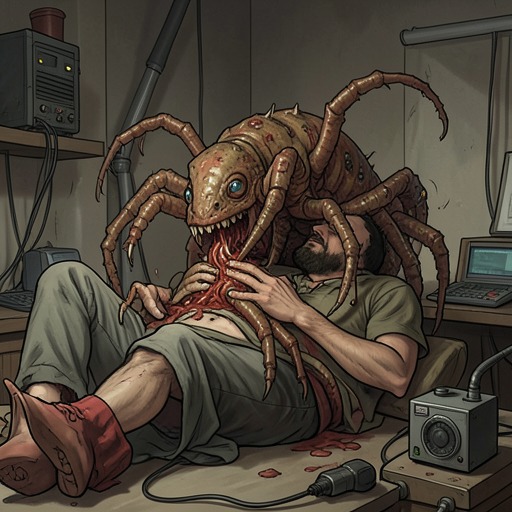
Naked LunchUn-D.T., short for Undifferentiated Tissue, is a spreading growth capable of becoming any kind of human flesh. In the account of a man whose body is overtaken by it, the tissue transforms an intimate bodily loss of control into a larger analogy for unchecked reproduction: the growth becomes both a physical threat and a figure for bureaucracies that expand by consuming their hosts.
Definition and Spread
Un-D.T. is described as transparent, jelly-like tissue that appears on the man’s mouth. When he tears it away, pieces adhere to his hands and can grow wherever they fall on his body. Its defining property is not a fixed shape but an open-ended capacity to develop into different forms of flesh. The account later imagines its scattered growths producing abnormal, randomly assembled bodies, from erectile tissue and exposed viscera to clusters of eyes and intermingled mouths and other parts.
The tissue’s growth is therefore presented as both local and proliferative: a patch can spread beyond its original site, while fragments can establish new growth elsewhere. That expansion ultimately closes off the man’s mouth and head. His eyes remain, but the narrative describes his neural connections as blocked, infiltrated, and atrophied; his brain can no longer issue commands, and the growth leaves him sealed within his skull. His eyes eventually cease to show feeling, marking the end of the account’s progression from invasion to the loss of agency and life.
Bodily Autonomy and the Censor
The Un-D.T. episode is introduced through a story of a man whose body first becomes difficult to control. His anus begins speaking independently, then develops the capacity to eat and to demand recognition. As the growth spreads, bodily boundaries and the distinction between the person and an independently acting part of him become increasingly unstable. The later tissue growth carries that loss of control beyond one organ: the body itself becomes material that can be redistributed and remade.
The narrative connects this grotesque bodily image to what can pass through censorship. It describes the tissue as a form of sexual material that slips between institutional barriers in popular songs and low-budget films, revealing what it calls an underlying American corruption. The comparison makes the tissue’s uncontrolled propagation a model for content and impulses that censorship cannot fully contain: what is blocked at one point can emerge elsewhere in distorted, proliferating forms.
Bureaucracy as a Cancerous Growth
The tissue’s biological logic becomes an explicit political analogy. The account calls cancer the end result of complete cellular representation and compares democracy and its bureaus to cancerous growth. A bureau takes root within the state, reproduces institutions of its own kind, and threatens to choke its host unless controlled or removed. Like Un-D.T., bureaucracy is depicted as parasitic: it depends on the body it inhabits while expanding at that body’s expense.
The passage contrasts this expansion with cooperatives that can function independently of the state and meet the needs of the people participating in them. A bureau, by contrast, is said to invent needs to justify its continued existence. The contrast gives the tissue analogy a specific political direction: the danger is not growth alone, but a form of growth that makes its host dependent and suppresses independent, spontaneous action.
Meaning and Narrative Function
Un-D.T. links bodily invasion, censorship, and institutional power through the shared image of unbounded reproduction. Its random forms suggest not a return to an intact original body but the production of increasingly unstable combinations. The image thus stands against differentiation and independent life: growth becomes malignant when it expands by absorbing or disabling what already exists.
The accompanying comparison between bureaucracy and a virus sharpens that warning. The virus is described as having lost the capacity for independent life and as displaying living qualities only through a host. In this framework, both the tissue and the bureau embody parasitic existence: they propagate, but not through self-sufficient life. Un-D.T. is therefore more than a fictional tissue growth; it is the passage’s material figure for systems that spread by replacing autonomy with dependence.